
Seller Tools
Thinking About Selling Your Dental Practice?
Free resources to help you prepare for a sale, understand the brokerage process, organize your next steps, and explore tools that may support recruiting and transition planning.
No sales pitch required. Enter your name and email once, and the resources unlock right here.
Which Resource Do You Need First?
Selling a dental practice is one of the biggest financial transactions of your career — and it rarely goes the way a handshake deal implies it will. Whether you already have a buyer in mind, you’re just starting to think about timing, or you’ve already signed a Letter of Intent, the process runs smoother with the right information in front of you at the right time.
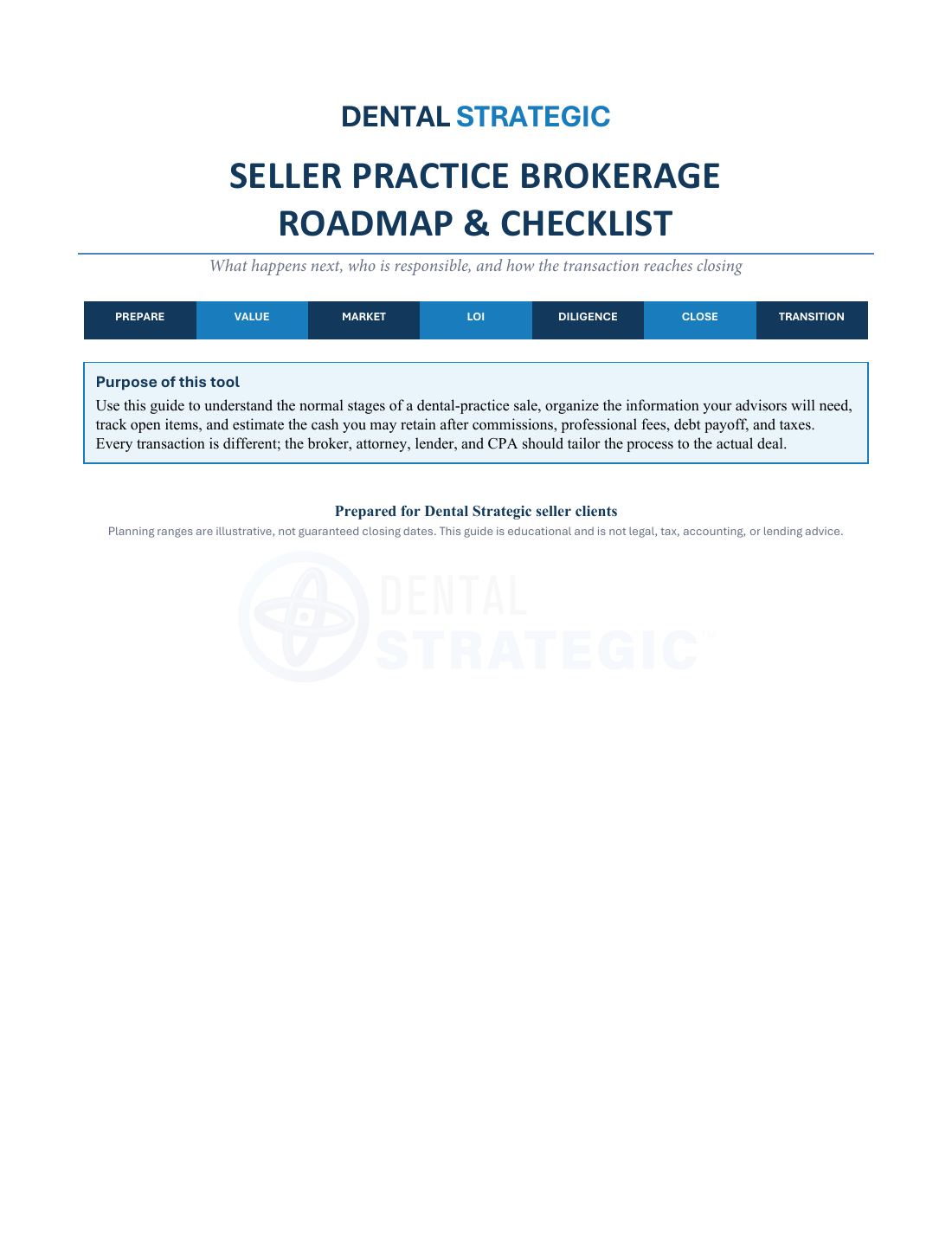
Seller Practice Brokerage Roadmap & Checklist
A phase-by-phase roadmap of your entire sale — Prepare through Transition — with checklists and a who-does-what table for every stage.
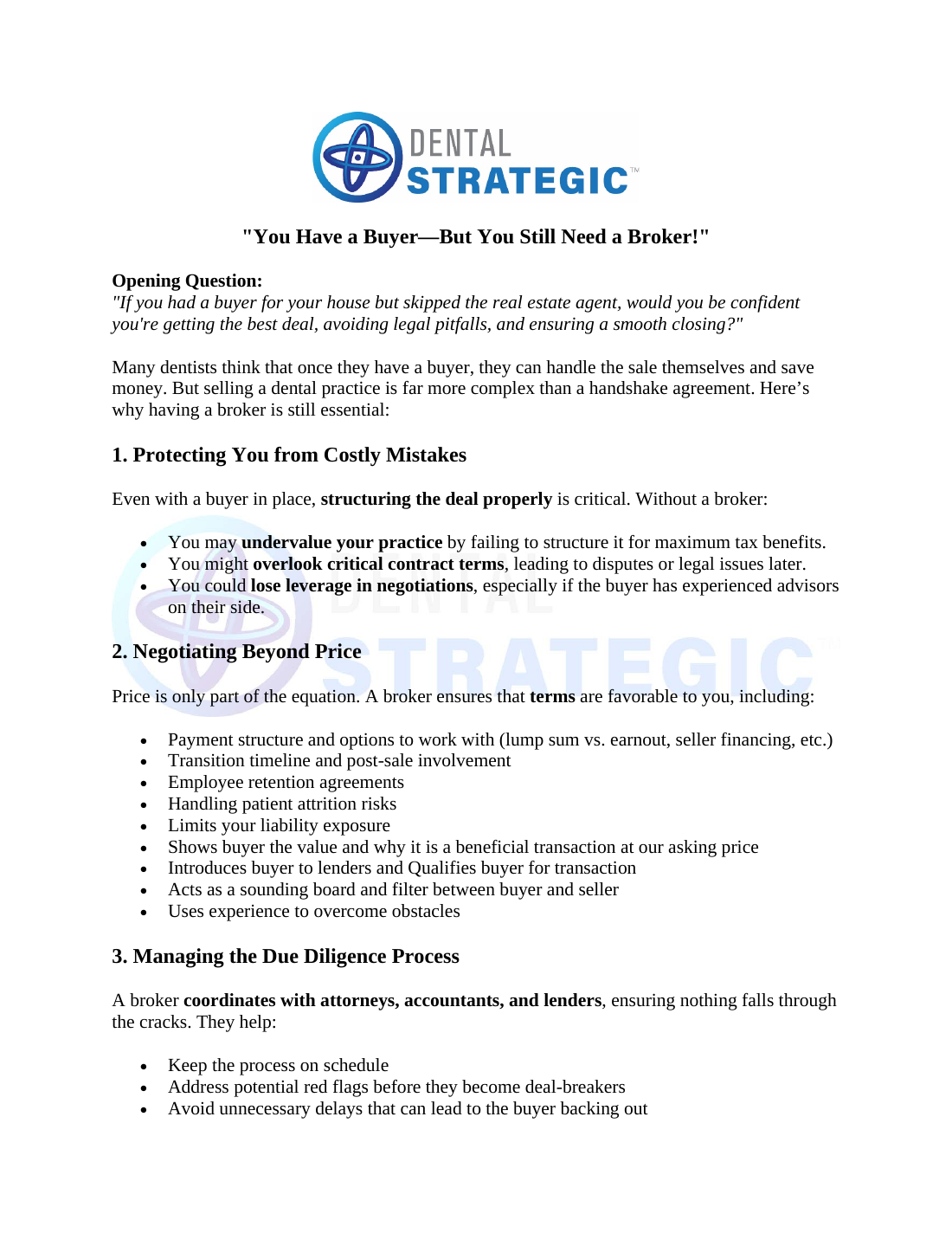
You Have a Buyer—But You Still Need a Broker
Already have a buyer? This short read covers five ways a broker still protects your deal and your take-home value.
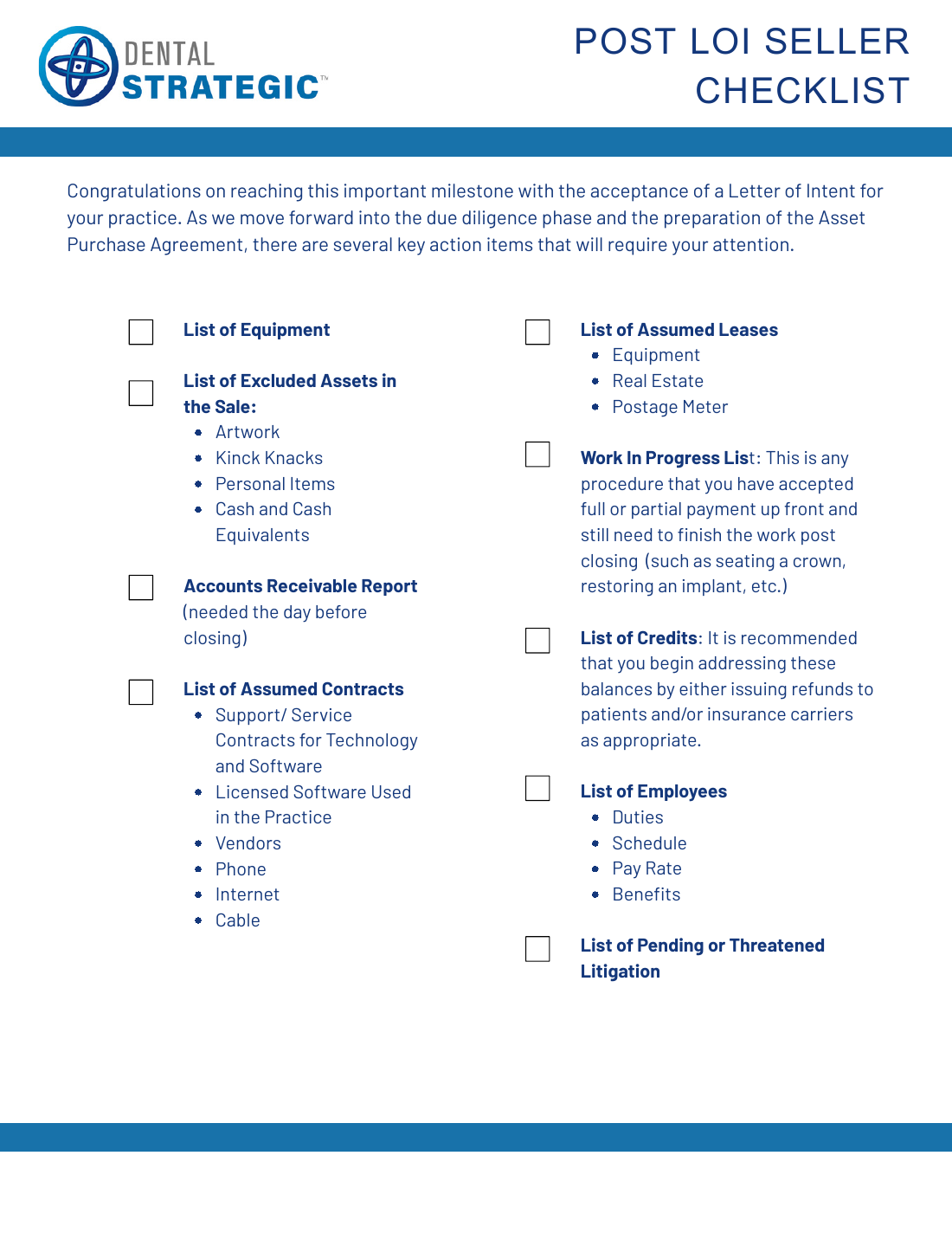
Post-LOI Seller Checklist
Signed a Letter of Intent? This one-page checklist covers the action items due diligence will ask for next.

Dentist Student Loan Relief Guide for Practice Owners
Understand how eligible programs may support associate recruiting and transition conversations, and what must be confirmed before quoting a benefit.
Get the Resources
Enter your name and email below to unlock the available seller resources. We continue to expand this toolbox with practical guides for planning, recruiting, and transitioning.
Prefer not to use the form, or running into trouble? Email us directly at DentalStrategic@Gmail.com or call 303-264-9727 and we’ll send the resources your way.
Seller Practice Brokerage Roadmap & Checklist
What Happens Next, Who’s Responsible, and How the Transaction Reaches Closing
A practice sale is not one task — it’s a coordinated sequence of valuation, financial preparation, confidential marketing, buyer qualification, negotiation, lender underwriting, legal documentation, closing mechanics, and transition. The steps overlap, and a delay in one workstream can affect every other one.
What’s inside:
- An 8-phase timeline at a glance: Readiness & Valuation, Engagement & Preparation, Confidential Marketing, Offer & LOI, Due Diligence, Pre-Closing, Closing, and Transition & Post-Closing.
- A “who does what” table — seller, broker, attorney, CPA, buyer, and lender — so you know exactly what to expect from each party.
- Phase-by-phase seller checklists you can work through with your broker.
- A section on why you still need a broker even once you already have a buyer.
- A plain-language look at what you’ll actually take home after commissions, fees, debt payoff, and taxes.
How to Use This Tool
Step 1: Start with the at-a-glance timeline to understand the major phases and typical timing.
Step 2: Use the phase checklists during regular calls with your Dental Strategic broker.
Step 3: Assign each open item to the seller, broker, attorney, CPA, buyer, lender, or another advisor.
Step 4: Update your net proceeds estimate as the purchase price, allocation, debt payoff, patient credits, and tax assumptions become clearer.
Why it matters: The key seller objective is to continue operating the practice normally while the transaction team handles the sale process — a sudden decline in production, staff turnover, or loss of key referral relationships can affect underwriting, buyer confidence, and the final value delivered at closing.
↑ Enter your info above to download the Seller Practice Brokerage Roadmap & Checklist.
You Have a Buyer—But You Still Need a Broker
“If You Had a Buyer for Your House but Skipped the Real Estate Agent…”
Many dentists think that once they have a buyer, they can handle the sale themselves and save money. But selling a dental practice is far more complex than a handshake agreement.
Five reasons a broker still matters:
- Protecting you from costly mistakes — undervaluing the practice, overlooking contract terms, or losing negotiating leverage.
- Negotiating beyond price — payment structure, transition timeline, employee retention, and liability exposure.
- Managing due diligence — keeping the process on schedule and catching red flags before they become deal-breakers.
- Compliance & legal protections — proper documentation, state regulations, and a fair, balanced contract.
- Maximizing your take-home value — often more than covering the broker’s fee.
How to Use This Tool
Step 1: Read it before your next conversation with your buyer, even if you feel confident about the relationship.
Step 2: Use the five reasons as a checklist of what to confirm is being handled, whether or not you decide to use a broker.
Why it matters: A buyer is not the same as a qualified buyer, an executable transaction, or a funded closing — you still need an experienced transaction manager to protect value, maintain leverage, and keep the parties moving through the difficult portions of the deal.
↑ Enter your info above to download “You Have a Buyer—But You Still Need a Broker.”
Post-LOI Seller Checklist
Congratulations — Now the Real Work Begins
Once a Letter of Intent is accepted, the due diligence phase and preparation of the Asset Purchase Agreement bring a specific set of action items that need your attention.
What you’ll organize:
- A list of equipment, and a separate list of excluded assets (artwork, personal items, cash equivalents).
- Your accounts receivable report (needed the day before closing).
- Assumed contracts (software, vendors, phone, internet, cable) and assumed leases (equipment, real estate, postage meter).
- A work-in-progress list — any procedure paid for up front that still needs to be finished post-closing.
- Credits owed to patients or insurance carriers, your employee list (duties, schedule, pay, benefits), and any pending or threatened litigation.
How to Use This Tool
Step 1: Pull this out as soon as your LOI is signed — don’t wait for your attorney or broker to ask.
Step 2: Work through each checkbox with your office manager, since several items (employee details, assumed contracts) need their input.
Step 3: Flag anything you’re unsure how to categorize (excluded vs. included) for your broker and attorney early, rather than at the closing table.
Why it matters: These schedules define exactly what transfers, what remains with you, and what facts support your legal representations — incomplete schedules can delay your attorney, the lender, and the closing statement itself.
↑ Enter your info above to download the Post-LOI Seller Checklist.
Dentist Student Loan Relief and Your Practice Transition
A qualifying loan-relief program may help a future associate, partner, or buyer evaluate a practice opportunity. This public educational guide explains the main pathways and the questions an owner should work through before marketing a possible benefit.
The exact site, clinician eligibility, entity structure, program approval, service terms, and current funding all matter. Awards are not automatic and should never be presented as guaranteed proceeds to a practice seller.
You Don’t Have to Navigate a Sale Alone
From Decision to Closing Day
Selling your practice is likely one of the most significant financial transactions of your career. Dental Strategic works with sellers through valuation, confidential marketing, negotiation, due diligence, and transition.
Our goal is to help you maximize your take-home value, avoid unnecessary surprises, and protect the practice you built — right up through closing day and beyond.
ASK A CONFIDENTIAL SELLER QUESTION
LEARN MORE ABOUT SELLING WITH DENTAL STRATEGIC
Dental Strategic | dentalstrategic.com
These educational tools are intended for planning purposes and do not replace individualized legal, tax, accounting, or lending advice.