
Your Path to Dental Practice Ownership Starts Here
Free tools to help you prepare, plan, and move forward with confidence — covering your finances, your readiness, your production, your agreement, and your first year as an owner.
No sales pitch required. Enter your name and email once, and all the tools unlock right here.
Which Tool Do You Need First?
You spent years learning how to practice dentistry. Now it’s time to learn how to own the practice. Whether you’re a dental student planning your future, an associate considering your first practice purchase, or a dentist preparing to build an office from the ground up, better preparation leads to better decisions.
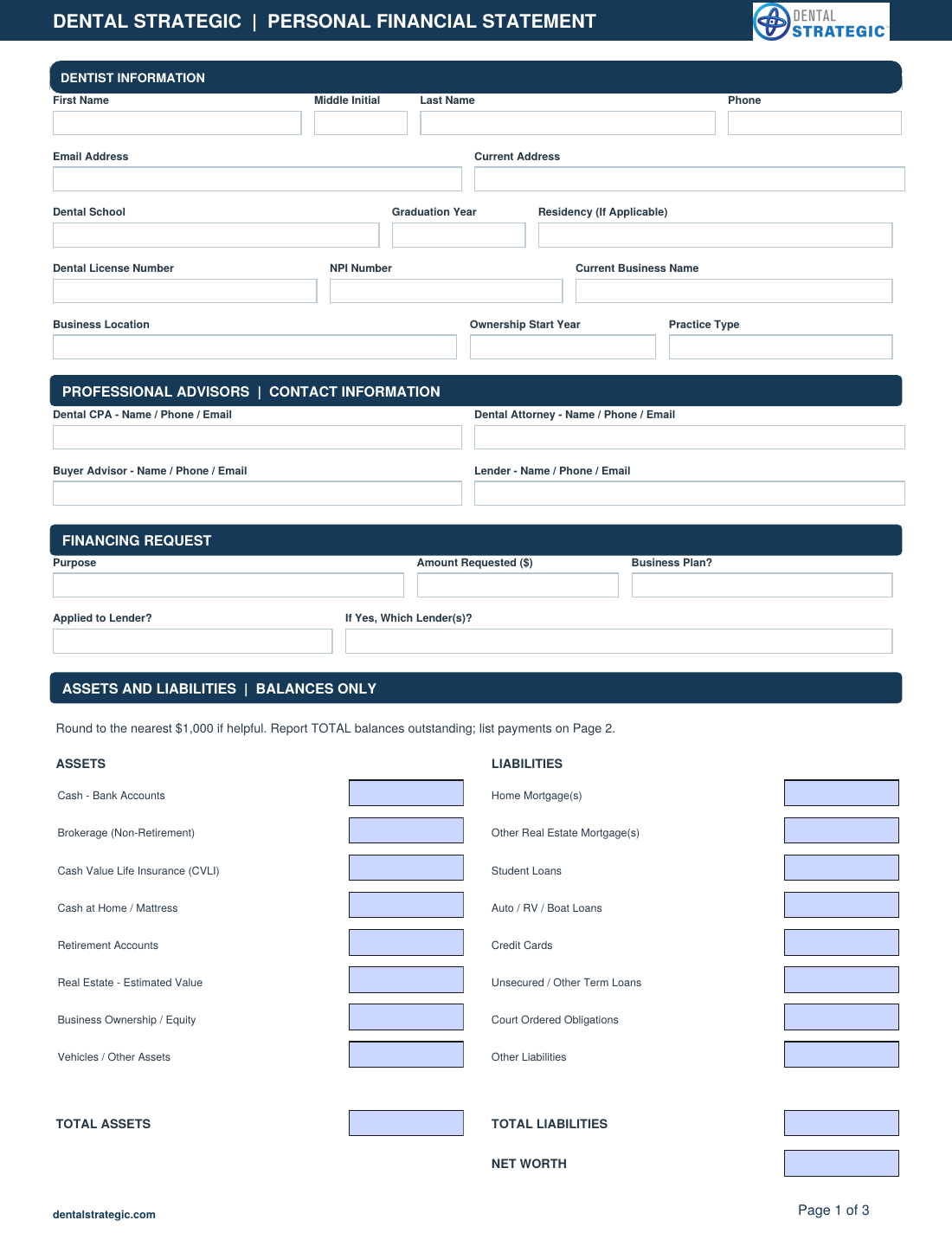
Personal Financial Statement
Organize your assets, debts, and net worth before you talk financing with a lender.
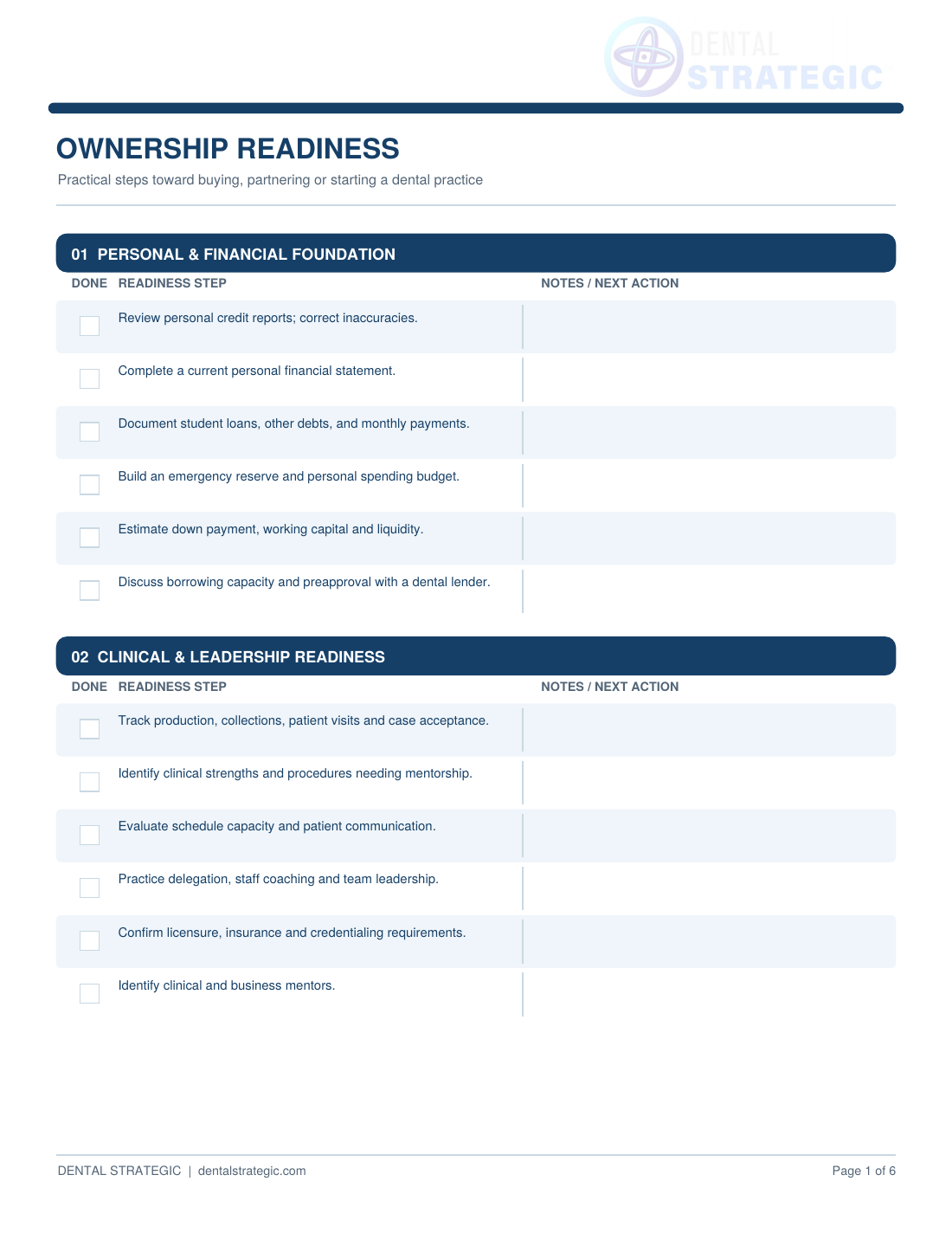
Ownership Readiness Checklist
A step-by-step readiness assessment covering finances, clinical skills, leadership, and timeline.
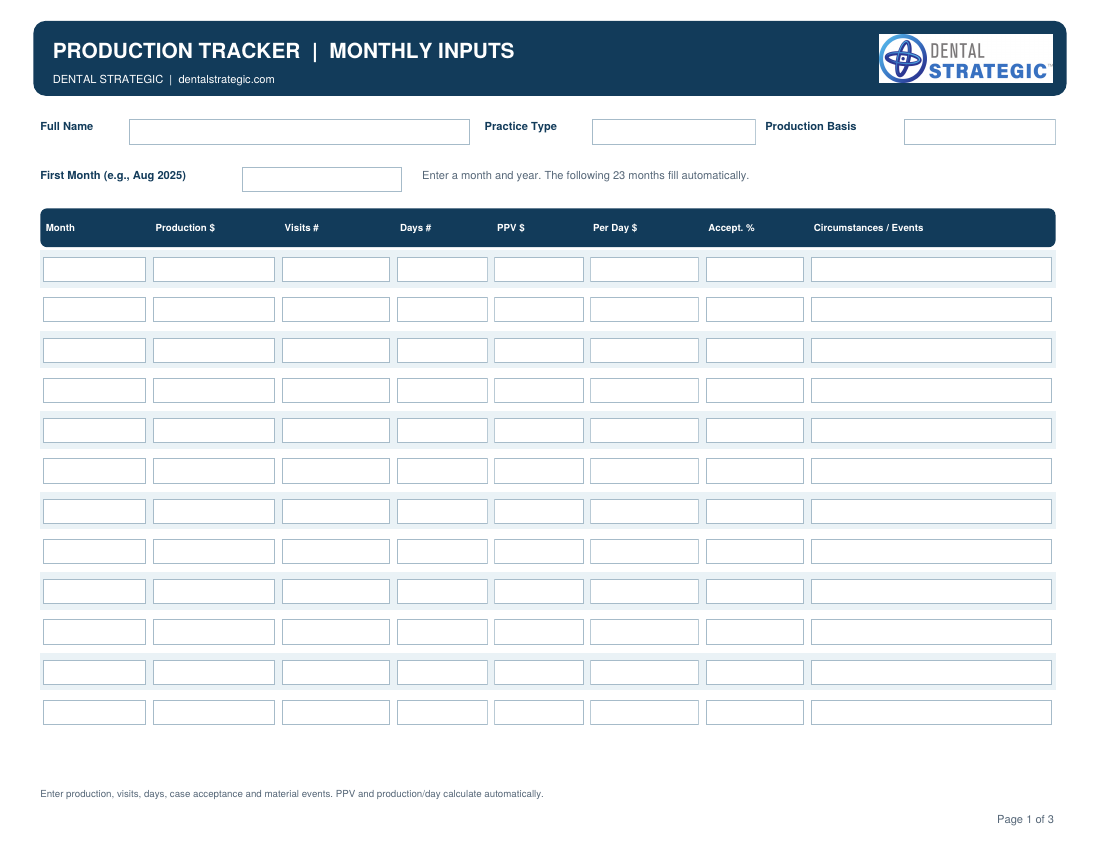
Production Tracker
Track monthly production, visits, and case acceptance to see your real performance trends.
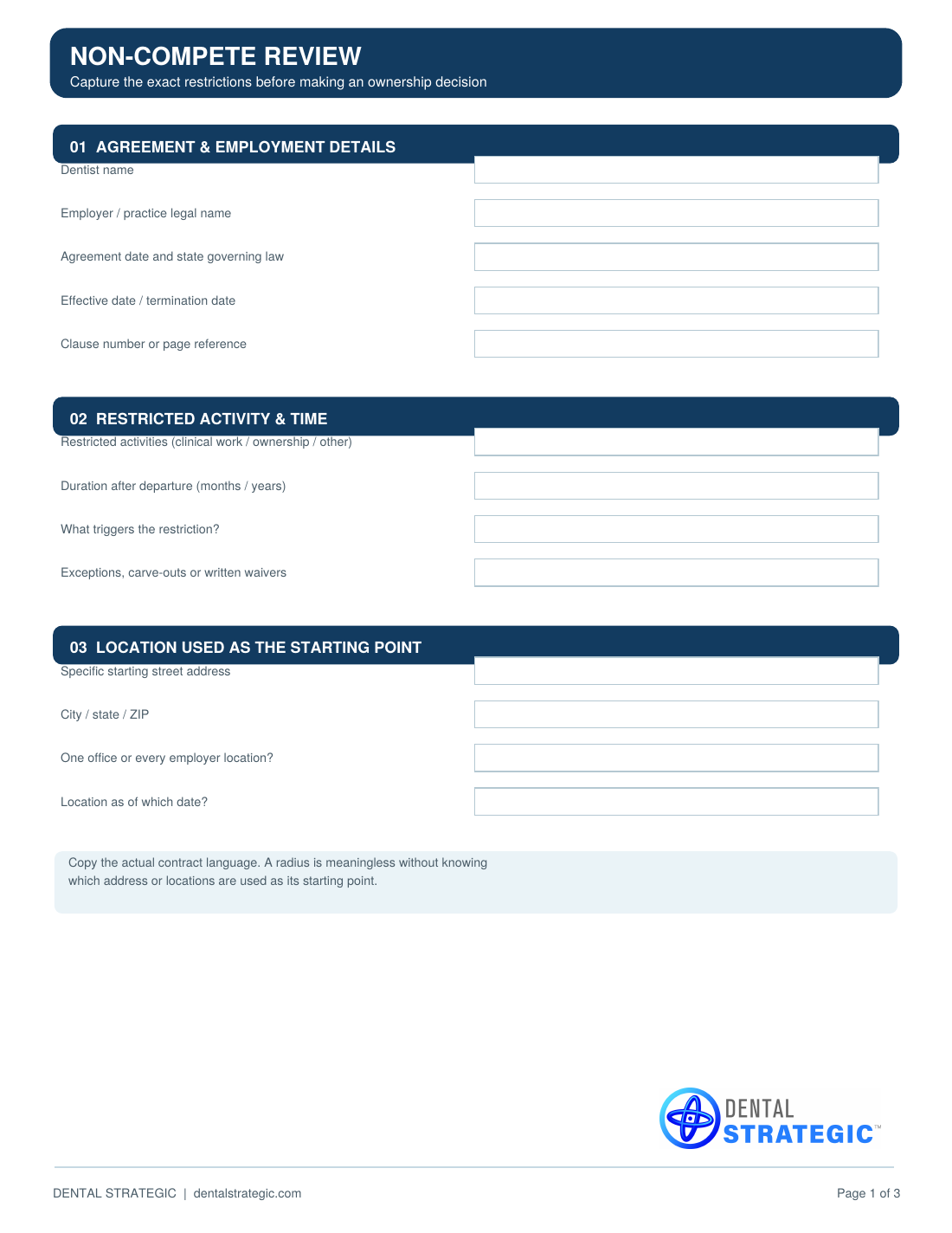
Non-Compete Review Worksheet
Organize your agreement’s restrictions before you commit to a location or call an attorney.
New Owner Guide & Workbook
A 50+ page roadmap for your first year: team, protocols, patient experience, marketing, and tracking.
Get All the Tools
Enter your name and email once below. All of the downloads below — the Personal Financial Statement, Ownership Readiness Checklist, Production Tracker, Non-Compete Review Worksheet, and New Owner Guide & Workbook — will unlock right here.
1. Personal Financial Statement
Know Where You Stand Before You Decide Where You’re Going
One of the first questions a lender will ask when evaluating a potential practice owner is whether the dentist is financially prepared to take on the responsibilities of ownership.
Our Personal Financial Statement helps you organize your assets, liabilities, existing debt obligations, and financial information in one place.
What you’ll evaluate:
- Personal assets, including cash, investments, retirement accounts, real estate, and other holdings.
- Outstanding liabilities, including student loans, mortgages, credit cards, and other obligations.
- Monthly and annual debt payments.
- Your estimated net worth.
- Financing needs and professional advisors.
How to Use This Tool
Step 1: Gather recent bank statements, investment balances, student loan information, and other debt statements.
Step 2: Complete the assets and liabilities section using current balances.
Step 3: Enter outstanding loans and required monthly payments in the debt schedule. An additional page is provided if you need more room. Student loans may be grouped when appropriate.
Step 4: Review the completed statement with a dental-focused lender or financial advisor to discuss borrowing capacity, liquidity, and potential financing needs.
Why it matters: Understanding your personal financial position early gives you time to address potential concerns before you find the practice you want to purchase.
↑ Enter your info above to download the Personal Financial Statement.
2. Ownership Readiness Checklist
Are You Ready to Own? Let’s Find Out.
Being a productive clinician and being a successful practice owner require overlapping—but different—skill sets.
Our Ownership Readiness Checklist helps you identify what you’ve already accomplished and what still needs attention.
The checklist covers personal finances, clinical readiness, leadership, practice selection, financing, professional advisors, due diligence, and the steps involved in transitioning into ownership.
What you’ll evaluate:
- Personal and financial preparation.
- Clinical confidence, production, and leadership skills.
- Your preferred path: purchasing, partnering, or starting a practice.
- Geographic preferences and ownership timeline.
- Your team of professional advisors.
- Practice evaluation, negotiations, financing, and transition planning.
How to Use This Tool
Step 1: Work through each section and check off the steps you’ve completed.
Step 2: Use the notes column to record questions, concerns, and actions that still need attention.
Step 3: Identify your most important unfinished tasks.
Step 4: Transfer those priorities to the Ownership Action Plan at the end of the checklist, including responsibility and target dates.
Step 5: Revisit the checklist as your experience, finances, and ownership plans evolve.
Why it matters: You may be closer to ownership than you think—or you may discover a few important areas where additional preparation could make a meaningful difference.
↑ Enter your info above to download the Ownership Readiness Checklist.
3. Track Your Production
Your Clinical Performance Tells a Story. Do You Know What Yours Is Saying?
Production is an important part of understanding your potential as a future practice owner.
But annual production alone doesn’t tell the entire story.
How much do you produce per patient visit? How productive are your clinical days? Are your results improving? How do schedule changes, procedure mix, and case acceptance affect your performance?
Our Production Tracker helps you evaluate these questions using your own numbers.
What you’ll track:
- Monthly production, using either gross or net production consistently.
- Number of patient visits.
- Number of clinical days worked.
- Production per visit.
- Production per clinical day.
- Case acceptance percentage.
- Special circumstances or events that affected results.
- Performance averages over the most recent 3, 6, 9, 12, 15, 18, and 24 months.
How to Use This Tool
Step 1: Ask your office manager or practice administrator for your monthly production and patient visit reports.
Step 2: Select whether you’re tracking gross or net production, and use that same basis consistently.
Step 3: Enter your starting month and monthly information. The worksheet is designed to calculate production per visit and per clinical day.
Step 4: Record unusual circumstances, such as extended vacations, changes in scheduling, new equipment, or differences in procedure mix.
Step 5: Review the trailing averages to identify trends in productivity, efficiency, and case acceptance.
Why it matters: A dentist who understands their production is better prepared to evaluate potential practice opportunities, estimate future revenue, and discuss realistic expectations with lenders and advisors.
And remember: Being busy and being productive are not necessarily the same thing.
↑ Enter your info above to download the Production Tracker.
4. Non-Compete Review Worksheet
Before You Fall in Love with a Location, Make Sure You Understand Your Agreement
You’ve found a great practice. The location is ideal, the numbers look promising, and you can already imagine your name on the sign.
There’s just one problem: Have you reviewed your existing employment agreement?
A non-compete or other restrictive covenant may affect your plans to purchase, start, or work in another practice. Understanding the exact language of your agreement should be part of your ownership planning.
Our Non-Compete Review Worksheet helps you organize the details before discussing them with a qualified dental attorney.
What you’ll evaluate:
- The effective date, duration, and applicable agreement language.
- Whether the restriction applies to employment, ownership, or other activities.
- The specific address used as the starting point.
- Whether distance is measured in miles, kilometers, driving distance, driving time, or straight-line radius.
- Whether the restriction applies to specific counties, cities, or ZIP codes.
- Whether restrictions extend to multiple offices, affiliates, or certain types of practices.
- The proposed address where you want to purchase or start your practice.
How to Use This Tool
Step 1: Locate your signed employment agreement and any subsequent amendments.
Step 2: Identify the exact language governing geographic restrictions, duration, and restricted activities.
Step 3: Record the starting address or addresses specified in the agreement.
Step 4: Enter the proposed location you’re considering.
Step 5: Use the included Google Maps link to compare addresses and document driving distance or travel time, where relevant. Remember that driving distance is not the same as straight-line distance.
Step 6: Review your findings with a qualified attorney before making a location or ownership commitment.
Why it matters: Identifying potential geographic restrictions early may save significant time and expense when evaluating a practice purchase or start-up location.
Important: This worksheet is an organizational tool, not a legal opinion. The enforceability of restrictive covenants depends on applicable law and the specific agreement.
↑ Enter your info above to download the Non-Compete Review Worksheet.
5. New Owner Guide & Workbook
You Closed on the Practice. Now What?
Owning a dental practice is a different job than practicing dentistry—and the first year sets the tone for everything that follows.
Our New Owner Guide & Workbook is a 50+ page roadmap built around the areas that make or break a new owner’s first year: your team, your protocols, your patients, your marketing, and the numbers that tell you how it’s all going.
What’s inside:
- Team: essential beliefs development, employee handbook guidance, team meetings, and team development.
- Administrative protocols and procedures.
- Restorative clinical procedures and protocols.
- Hygiene clinical procedures and protocols.
- Patient experience.
- Marketing.
- Business review process.
- A New Owner “To-Do” List and a Preferred Partners Recommendation Guide.
How to Use This Tool
Step 1: Read the Executive Summary and skim the Table of Contents to see the full roadmap.
Step 2: Work through each section in order, using the fillable workbook pages to draft your own essential beliefs, protocols, and plans—don’t just adopt the examples as-is.
Step 3: Use the New Owner “To-Do” List as your first 90-day checklist.
Step 4: Keep the Preferred Partners Recommendation Guide handy as you build out your vendor and advisor relationships.
Why it matters: A clear plan for your team, protocols, and patient experience in year one keeps you focused on patient care instead of putting out fires.
↑ Enter your info above to download the New Owner Guide & Workbook.
Where Should You Start?
Different Tools. One Bigger Picture.
Each resource answers a different question about your readiness for—and first year of—ownership.
| Tool | The Question It Helps Answer |
|---|---|
| Personal Financial Statement | Where do I stand financially? |
| Ownership Readiness Checklist | What do I still need to accomplish? |
| Production Tracker | What does my clinical performance tell me? |
| Non-Compete Review | Where can I realistically consider practicing? |
| New Owner Guide & Workbook | How do I run the first year well? |
Our suggested order: Start with the Ownership Readiness Checklist to identify your priorities. Complete your Personal Financial Statement and Production Tracker to establish your financial and clinical baseline. Review your employment restrictions before committing to a particular location. Then, once you’re under contract or closing on a practice, turn to the New Owner Guide & Workbook to plan your first year.
Together, these tools can help turn the idea of ownership into an actionable plan.
You Don’t Have to Figure Out Ownership Alone
From Associate to Owner. From Idea to Open Doors.
Buying a dental practice, joining a partnership, or starting an office from scratch can be one of the most significant professional and financial decisions of your career.
Dental Strategic works with dentists through the planning, evaluation, financing coordination, and transition process.
Our goal is to help you make informed decisions, avoid unnecessary surprises, and spend more of your time doing what you trained to do: taking care of patients.
Whether ownership is six months away or five years down the road, it’s never too early to start preparing.
ASK A CONFIDENTIAL OWNERSHIP QUESTION
EXPLORE PRACTICE PURCHASE OPPORTUNITIES
Dental Strategic | dentalstrategic.com
These educational tools are intended for planning purposes and do not replace individualized legal, tax, accounting, or lending advice.